Wednesday, August 25, 2010

Mobile interfaces

Well never done this before, but just loved this post from the Amnesia Blog that i had to copy the whole thing here. Awesome mobile interface stuff and yet another reason why i'm backing Android to be the dominant, universal OS of the future. Thanks @eunmac and @razorfish


The future of the mobile UI is behind a velvet curtain

I have seen concepts from this company before (more about this below) and they always seem to be taking different approaches to the rest of the world.

The Astonishing Tribe (TAT) has yet again showcased a UI they call Velvet – pull out a widget or Google Maps query, and a sheet of your desired result waves with the virtual wind, before stretching out flat for you to more comfortably interact with.

This is what TAT has to say about the Tablet UIs out there and why they are different:

On one hand we have companies that scale phone UIs to tablets. On the other hand we have companies offering the full blown desktop experience scaled down to tablet size. We believe that both of these approaches will result in crippled user experiences. For example, the tablet form factor is perfect for media consumption and this could be manifested in the UI. TAT recognizes tablets as a radically different type of device – personal and mobile yet powerful and creative. We are now on a quest to design fantastic UIs that are optimized for this device space.

Here is the Velvet UI in action

As I said before these guys have some pretty awesome, yet radical ideas – check this augmented reality ID out – TAT augmented ID

I have an Android phone and I have been looking for a decent home screen and I really hope this little beauty will hit the market at some time soon – TAT Home

These guys are definitely someone to look out for in the future – if you want to learn more about them, check out their blog


Tuesday, August 24, 2010

Gaming... serious business

Love the thinking around social being 'done' (from tech perspective at least), about reality being 'broken' and the general divergence and convergence between the real world and game driven environments.
Approaches utilising understanding of what drives engagement and motivates interaction are definitely going to be at the core of the next digital wave.

Thanks TED and DICE2010 for these great talks:


Also recommend reading Jane McGonigal's paper on Engagement Economy http://www.iftf.org/node/2306


Tuesday, August 10, 2010

Now this is a service - Ticketfree

An awesome utility idea that i would so use - thanks Springwise


More than 41 million speeding tickets are issued to drivers in the United States each year, according to TrafficTicketSecrets.com. With an average cost of USD 150 each, that amounts to more than USD 6 billion lost annually by US consumers. Therein lies the motivation behind Ticketfree, a site that ensures its customers will “never pay a speeding ticket, red light ticket, photo radar ticket or traffic violation again.”

Canadian Ticketfree operates on a simple membership plan whereby an annual fee covers the costs of any tickets members get over the course of that year. A membership fee of USD 169 covers all speeding tickets for a year, up to a maximum of USD 600; for USD 299, red-light and photo-radar tickets are covered as well, up to a cap of USD 900; and a USD 449 fee buys coverage for all of the above plus parking and equipment tickets too, up to a maximum total of USD 1,200. Upon receiving a qualifying ticket, members simply visit the Ticketfree site and enter the details; the company will then pay the associated fine and send the member a confirmation email. Not covered by Ticketfree are DUI and other violations resulting from dangerous behaviour, the company says.

Ticketing is on the rise, Ticketfree notes, so a little peace of mind could go a long way for many frequent drivers. Currently, however, the company covers only those within the United States and Canada; one to emulate in other parts of the ticket-prone and lead-footed world...? (Related: Fare dodgers take Paris Métro for a ride with insurance pots against fines.)

Website:www.ticketfree.org
Contact: general@ticketfree.ca

Spotted by: Michael Henr

Wednesday, August 4, 2010

Facebook Research: Brands Lean on Interactive Marketing –Yet Lack Social Marketing Skills

Nice framework approach from Jeremiah Owyang on how to approach, and rate, your facebook page activity.

This is followup data from the Altimeter Report: The 8 Success Criteria For Facebook Page Marketing, you should read this first.

Thanks to your help, Altimeter Group’s latest research on Facebook Marketing Best Practices, which now has over 17,000 views, and over 1,900 downloads (see slideshare stats) in less than a week. While we tried to include as much helpful information in the report, it was only the highlights of our findings. There’s far more data, scorecards, and findings that just aren’t able to fit into the report. Below is some additional information from our quantitative and qualitative study about the findings. Expect us to share more helpful data to marketers over the coming weeks, Altimeter clients can contact us for more details from the specific criteria, data, screenshots and scorecard.


[A fundamental mindset change must occur as brands approach social networks. In addition to interactive marketing (human-to-computer) brands must add social marketing (peer-to-peer) to their playbook.]


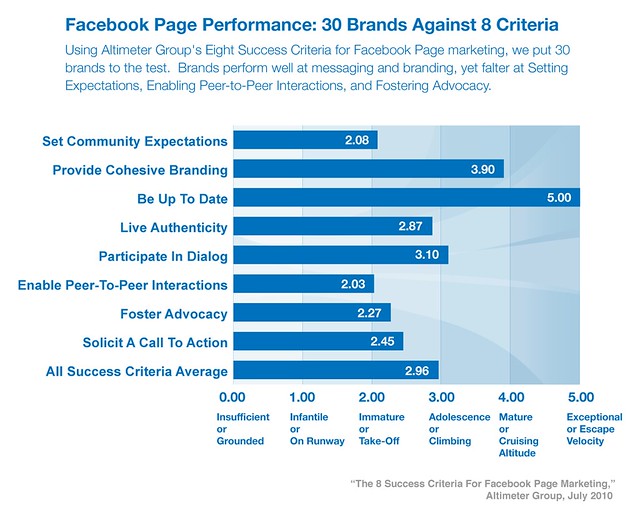
In the below graphic, we’ve aggregated the scores of the 30 brands to find out which of the criteria they’re good at –and which ones there are missed opportunities. We’ve then provided additional analysis on why we think brands scored this way, and some recommendations to improve.
Research Graphic: Brands Great at Messaging and Branding –Yet Lack at Setting Expectations, Peer to Peer, and Advovacy

Facebook Page Performance: 30 Brands Against 8 Criteria

Criteria How They Scored Our Take: Why Brands Performed This Way How Brands Can Improve Their Score
Set Community Expectations 2.08 (Immature or”Take off”) Brands failed to be clear why they were doing a Facebook effort, likely due to the fact that they jumped into the the social network bandwagon. Most brands are experimenting, and are unable to articulate their purpose Clearly have a business objective and be sure the site goals cascades these objectives. By not doing so, sets company up for a potential backlash as unchecked or unsolved customer woes can quickly cascade to their friends, on brands owns pages.
Provide Cohesive Branding 3.90 (Adolescence or “Climbing”) Brands showed some sophistication from over a decade of online interactive marketing has taught them how to cascade their experience to all touch points This is a huge risk. Customer that have product complaints may echo them loudly here, and if the brand doesn’t respond, this public griping could escalate into a full blown groundswell. Continue to reflect the brand in all digital channels, but don’t overwhelm the member experience.
Be Up To Date 5.00 (Exceptional or “Escape Velocity”) Brands have a strong legacy of broadcast marketing, which is also know as message bombardment. Brands demonstrated an incredible ability to propagate messages at a rapid rate, not unusual for other mediums as well. Continue this energy of being interactive with their customers, but in addition to populating the Facebook page with up to date updates, ensure they are engaging in a two-way dialog.
Live Authenticity 2.87 (Immature or”Take off”) Brands suffered at being ’social’ in a social network, and are in many cases afraid to show their human side. Decades of being logo centric has cascaded to social networks and most members may question having conversations with a logo. Behave in the same way the members are behaving: be social. Put the human side first by showing the team photos, giving human replies, and responding with first and last name.
Participate in Dialog 3.10 (Adolescence or “Climbing”) Mixed bag of performance, while some brands may interact, often it was inconsistent. Even after a few years of social marketing blogging, forums, and Twitter, brands are still struggling to have real conversations with their members. Interact with customers by engaging in a two way conversation. To scale, you don’t need to respond to every message, but set expectations on how frequently you’ll respond.
Enable Peer to Peer Interactions 2.03 (Immature or”Take off”) Poor performance from brands here. In many cases, we expect brands hid from these features as they are difficult to moderate, manage, and risk of conversations going awry. Better features are needed by using third party community applications, as well as hiring seasoned, well trained community managers to monitor and moderate.
Foster Advocacy 2.27 (Immature or”Take off”) Brands are barely able to participate in the conversation let alone rely on the advanced features such as sharing or using your own members to share on your behalf. At the bare minimum, encourage members to share content with each other and to cascade the branded experience to friends. As brands gain confidence, create formal advocacy programs.
Solicit a Call to Action 2.45 (Immature or”Take off”) Unsure of even interacting with their members, it’s no surprise they didn’t know how to engage them for next steps or even conversion. Don’t rush this. Until you’re scoring 4 or above on the previous mentioned criteria, I encourage brands to avoid this. Yet, for those that are succeeding in the other criteria, they can help members with conversion.

Summary: Brands Must Learn Social Marketing –Beyond Interactive Marketing

Brands are applying their years of experience of applying interactive marketing and broadcast marketing to the social web and it shows. With the natural inclination to brand and broadcast, we see these same behaviors in the Facebook Marketing. Yet, despite these existing strengths, brands are missing the two way aspect or ’social aspect’ of social network marketing. They must start to leverage peer to peer communications to reduce costs and content publication, show their human side, and quickly set expectations of what’s required –or risk a brand backlash. While setting community expectations doesn’t guarantee that a customer backlash could occur, it could help funnel them to the right place to be quickly supported. Yet, as problems are resolved, don’t shove them under the carpet in the call center, be sure to indicate back to the community they’ve been solved. Above all, brands must change their mindset from interactive marketing (human to computer) to also include social marketing (human to human)

Tuesday, August 3, 2010

SMS slingshot

Some cool interactive projection stuff, Thanks Digital Buzz blog.

Always amazes me that this sort of stuff just doesn't seem to have much uptake in Australia


Sony's 360 degree display

WOW... imagine this on a really really large scale