Monday, January 12, 2009

Meet the 'New Info Shopper'

This article is merely stating the obvious but it's good to have on record for any clients needing the facts.


New Info Shoppers
By MARK PENN thanks to WSJ

With so much attention on psychological marketing these days -- finding new ways to tap into people's heads -- perhaps the single most neglected trend out there is the move towards more hard-nosed information-based shopping and purchasing.

While elites were busy shoveling money into Madoff's black box these past few years, strapped consumers have been poring over product spec sheets, third-party reviews and expert blog sites. This past holiday season they watched every dollar. A special kind of consumer has taken a major role in the marketplace -- the new info shopper. These people just can't buy anything unless they first look it up online and get the lowdown.

These shoppers have the Internet at work, typically hold information-based or office-park jobs, have some college or grad school, and are often making ends meet with two jobs, kids, and pets on a middle or upper-middle-class income.

Forget about huge, sweeping megaforces. The biggest trends today are micro: small, under-the-radar patterns of behavior which take on real power when propelled by modern communications and an increasingly independent-minded population. In the U.S., one percent of the nation, or three million people, can create new markets for a business, spark a social movement, or produce political change. This column is about identifying these important new niches, and acting on that knowledge.

They have become highly suspicious of many TV ads: in a shoppers survey we did, 78% of them said that ads no longer have enough information they need. So many of them search online for virtually everything. Window shoppers have become "Windows shoppers." They want, in the phrase often attributed to Dragnet's Joe Friday, "just the facts, ma'am."

Of course, there is still a healthy role for big emotional brand appeals and mega-advertising campaigns. For every trend there is a counter trend. But that's not the real new thing in consumer behavior.

A whopping 92% of respondents said they had more confidence in information they seek out online than anything coming from a salesclerk or other source. They believe the information they find, not in the information that is spoon-fed to them, and the vast number of clicks today prove that they really are devoting time and energy to ferreting out detailed info before they buy.

A good example of how information can transform a marketplace is the series of ads a few years ago for the Dyson vacuum cleaner. Founder and inventor James Dyson took a commonplace item and explained how he had transformed it with new scientific principles. Consumers weren't bored with the technical approach. On the contrary, sales took off -- and changed the marketplace for vacuum cleaners.

When we asked shoppers whether they would do online research before buying a vacuum cleaner today, a surprising 58% said that's exactly what they would do. His ads helped turn vacuum-cleaner buying into a largely information-based marketplace.

We have seen many of the big market areas convert to an information-driven model -- cars, homes, personal computers and medical care are areas where nearly 4 in 5 shoppers say they gather information on their own from the Web before buying. "Do-it-yourself doctors" (that is, info patients) show up at their doctor with the Web-derived diagnosis in hand, and a list of the medicines they need prescribed. Customers appear at the car dealership with the wholesale price and the model already picked out.

Information-seeking is not just an activity, it's a way of looking at the world. New info shoppers are proud of the progress they have made in putting facts over pablum. More companies should treat their customers as Dyson did and let them in on the secrets of their unique success. And they should invest more than ever in helping form their consumers into citizen corps, arming them with PCs, cameras and even asking them to use the phone's new video cameras to document their product usage and put them online.

But how many marketers today work back from what this new consumer is thinking and doing? Not many. Based on the advertising budgets in the U.S. where a typical company will spend 60 times as much on advertising than they spend on generating publicity, most lag way behind in creating a new model of consumers and the steps they take before they buy.

Some industries got it right away. Movies and restaurants have huge word of mouth and impulse components, but they are also very information-driven. Zagat's pioneered the concept of survey ratings and reviews, and smart restaurants use them. We're seeing the same in entertainment, where Metacritic and others provide professional and customer ratings of every movie.

Now this trend is spreading down the product chain. In our survey, 24% said they are doing online research before buying shampoo. The Breck Girl is being replaced by a shopping bot.

And they have questions. How does this shampoo work on different hair types, thicknesses and colors? Are the bottles recyclable? Has the product been tested on animals?

It used to be that the only time people expected 30-page, pre-purchase, inspection reports was when they were buying a house. Now some people want them just to buy a tube of toothpaste.

The point is that advertising isn't just moving to the Web, it's got to grapple with an entirely new kind of shopper and way of shopping. Marketers now have to balance traditional media, online media, and content that is generated by experts, bloggers and consumers themselves. An astonishing 70% of Americans now say they consult product reviews or consumer ratings before they make their buying decisions. Sixty-two percent say they spend at least 30 minutes online every week to help them decide what and whether to buy. Among Americans under 45, that number shoots up to 73%. Seventy-three percent -- that's more than four times the percentage in that age group who go to church every week. For some, smart shopping is more than a hobby. It's a religion.

Information aggregation sites – the ones that don't generate content themselves, but link to others' content, weaving a story about the industry and its products -- will become even more important. Much as the Drudge Report tells its readers where to find stories they will like, so consumer aggregation sites could grow and do the same for car buyers, PC buyers, and other consumer groups. Most of the sites so far have been too cheesy to really catch on.

Information shopping also means manufacturers have to get back to generating more information on their products, even offbeat factoids that are highly memorable if not always useful. Timex sold a lot of watches by showing its watches were still ticking after being thrown into a washing machine. To catch the eye of the info-shopping consumer, manufacturers should start hauling their wares up to Mt. Everest, drop them out of windows, put them in boiling water and reporting on how they do. In an info-seeking world, facts can again become the great differentiator.

New Info Shoppers are bigger than a microtrend. They represent a broad shift in the marketplace brought about by the Internet, higher education, and changing economic times. But the question is when is the marketplace is going to really catch up to them.

Image thanks to: http://informedbuying.net/computer_shopcart.JPG

In the words of Simon - Genius

This is probably the best application I've seen yet - aiding justification for deleting those people that you just don't care about. What's more is that its practical for the brand also.
Thanks to Adweek and Simon Mc for this post.

BK Offers Facebook 'Sacrifice'
Cut 10 friends, earn a free Whopper

Jan 8, 2009
-By Brian Morrissey


NEW YORK It's a common problem for anyone who joined Facebook some time ago. You look at your friend list and wonder who these people are. Burger King wants to help consumers do something about it.

The fast-food chain has released the Whopper Sacrifice application on Facebook. The app rewards people with a coupon for BK's signature burger when they cull 10 friends. Each time a friend is excommunicated, the application sends a notification to the banished party via Facebook's news feed explaining that the user's love for the unlucky soul is less than his or her zeal for the Whopper.

The effort crafted by Crispin Porter + Bogusky came about after agency creative staffers confronted the too-many-friends scenario themselves on Facebook.

"We thought there could be some fun there, removing some of these people who are friends [but] not necessarily] best friends," said Jeff Benjamin, executive interactive creative director at Crispin, and friend to 736 on Facebook. "It's asking the question of which love is bigger, your love for your friends or your love for the Whopper," he said.

The app also adds a box to user profile pages charting their progress toward the free burger with the line, "Who will be the next to go?"

The application is available on Facebook and at WhopperSacrifice.com.

Whopper Sacrifice is the second application Crispin has built for BK. During the election, it released the BK Polarizer, a quiz widget that gauged where users stood on a political matrix compared to their friends.

Brand applications have a spotty record on Facebook, with few enjoying more than a temporary jolt in popularity before quickly fizzling. Some brands have begun rewarding consumers for installing their apps. One example is Kraft's current campaign that includes donations of meals to needy families when users get their friends to add the Kraft Facebook app.

"We always look at these social networks and think of what tool or thing we wish was here," Benjamin said. "A lot of times, brands force a feature or an application that I don't think people ever want. That's when you can waste some money."

The notion of dumping friends in exchange for a burger could offend some, though Crispin has not shied from controversy with BK. Its recent "Whopper Virgins" campaign, showing people in remote areas of the world introduced to fast food, came under fire from many critics. Benjamin said the agency and client were careful to make the application lighthearted rather than "vindictive."


"The [friend] removal is another kind of socializing," he said. "At first you think it's antisocial, but it's a social device. Now we finally have something to talk about."

Wednesday, January 7, 2009

10 Tips for 360° Marketing - Metallica vs Yael Naim: Steamroller vs Word of Mouth

Thanks futurelab for this rundown of how to work on all fronts

Guest Post by: Frédéric Baffou

Procter & Gamble, Coca Cola or Nike are experts in steamroller approach when it comes to a worldwide product launch.

What about a Rock Band?
Metallica
, one of the most popular metal band in the world, released one month ago their new album : Death Magnetic.
:-) and yes..I am a fan of this band since the beginning.

After one month of sales, they have reached 1 million copies sold (source: Nielsen SoundScan) with almost half of them done within the first 3 days after the launch. They secured the all-time record for most consecutive #1 debuts in chart history!

I wanted to understand how they have supported the launch of this new album. In the meantime, I looked at the song New Soul (from Yael Naim) which became popular around the planet earlier this year thanks to the commercial for the Apple Macbook Air. This approach based on Word of Mouth (WoM) led the album of this young girl entering the top 10 of the Billboard Hot 100. Only 18 songs have done so since 2000.

At the end of the day, some marketing Tips can be identified based on these experiences.

A very good execution of a 360° Marketing strategy
One of the principle of being Customer Centric is to approach with consistency the consumer from many different angles. Metallica is definitely a master (of puppets) on this battle ground.
They have used the full scope of marketing tools before, during and after the release of their new CD. The support stems from pre-launch website to CRM through community based tools.

What did Metallica control?
The different building blocks are organized with consistency and interacting across each other which contributed to expand the snow ball effect.
You can click on each of the image to get the details of various examples.

Branding mmm Pre-Launch Website Main Website
Metallica Branding Mission Metallica websiteMetallica website (main)

Advertising
Metallica Widget Metallica Web Banner

Video games mmm Goodies m Music
Guitar Hero game websitemm Metallica Goodies mmLast FM website

Interviews mmmmmmm mTV Shows mmmmm Concerts
Rollin Stone interview TV Show Zvents Concerts

Social networks
Dailymotion & Metallica Myspace & Metallica Metallica TV on You Tube Yahoo Music

What did Metallica NOT control?
Quality of sound
In the meantime, they have been exposed to a polemic about the sound quality of their new album. Many fans claimed that the sound was too loud which created a major buzz. Even, The Wall Street Journal published a detailed article on the subject 2 weeks after the official release of the album. It led Lars Ulrich (drummer) to make a public statement few days later. However, the Buzz is still on air! A petition which has collected more than 15 000 signatures is growing everyday.
Length of songs
The band had contributed to the end of the free Peer To Peer (P2P) platform, Napster. However, some original new songs were circulating on the web but had been remastered by a fan to be shorter than original tracks (7′ in average).
The Swedish newspaper Sydsvenskan commented positively this initiative. Universal Music issued a press release and cancelled the interview planned with the journalist. This local event was largely commented internationally on the web beyond the fans’ community.

What is the result?
Metallica
achieved a record sales supported by a major investment. The main challenge is now to maintain such level of performance while keeping a genuine interactivity with fans.
Yael Naim has reached a worldwide awareness thanks to her talent (and David Donatien), an album done in their apartment and a 30 secs advertisement…Not bad in terms on ROI.
She was opportunistic, flexible and build momentum when Apple’s commercial pushed her over the Tipping Point. WoM was the main vehicle benefiting from a very good fit between Apple’s brand image and the music.
Metallica and Yael Naim have aligned their resources with their goals. However, they have in common one fundamental which is the quality of their “product” as both people and critics have appreciated a lot their music.

360marketing_FB.jpg

10 Tips to practice efficiently 360° Marketing
1-
Define first a clear set of goals and the related strategy
2-
Understand well your audiences/consumers and the way they use & interact with your brand(s)/products (incl. opinion leaders)
3-
Identify clearly the different marketing channels (and their mix) that consumers are using (and not using) to get informed, to communicate, to entertain, to try and to purchase
4-
Define the most appropriate channel(s) related to the status of your consumers (e.g. acquisition vs loyalty) and allocate a precise role to each of them
5-
Keep always the ears, the eyes opened to what is going on the maket
6- Deliver a message
if it brings value to your clients or audiences
7-
Be consistent within and across all channels (one size doesn’t fit all) and produce regularly new content
8-
Seek feedback and involvement from consumers and integrate it in the next steps
9-
Measure, benchmark and allocate resources accordingly, i.e Quality over Quantity
10-
Keep in mind that the best advocate about your products is NOT the brand but the consumer


Really lazy post with some stuff i found last year

From Contagious - a story about a cool geotagged, mobile documentary in South Africa: http://tinyurl.com/56lhdd

Uniqlo's Human vending machine, from PSFK: http://tinyurl.com/6tzfok

Cool street art location community: http://www.streetartlocator.com/

Techcrunch article about predicting the success of youtube videos: Researcher Claims “Attention Spirals” Hold Key To Predicting Success Of YouTube Videos

Cool community build around 3D modelling / printing and creation of objects: http://www.shapeways.com/

And finally, the full text from a Social Media Success Story by Econsulantcy:

I'm a professed 'social media' skeptic. I believe that much of the hype around social media is unjustified.

I believe anyone arguing that every corporation should be seeking out 'conversations' and becoming 'friends' with customers on social networks largely reflects a misguided and naive marketing philosophy.

That said, I don't doubt the power of 'connection' and 'community.'

Before the phrases 'Web 2.0' and 'social media' had even been coined, I had been intimately involved in the creation and development of websites with strong community components. All told, these websites had generated hundreds of thousands of thousands of registered users and millions upon millions of interactions in the form of message board posts, content uploads and user-to-user communications before Friendster had even launched.

I still employ 'connection' and 'community' to this day in several of my online ventures, although I would argue that artificial attempts at getting consumers to develop relationships around toothpaste and laundry detergent are not the best uses of these concepts.

If one considers that 'connection' and 'community' are the key components of 'social media,' there is perhaps no better recent case study highlighting how social media can be applied in a truly effective manner than the Twilight series of vampire-romance novels that teenagers have really bitten into.

If Twilight sounds familiar to you, it may be because the movie adaptation of the first Twilight novel (also called Twilight) was recently released and in less than 10 days grossed nearly $100mn. Blockbuster status, to be sure.

How did a then 32 year-old stay-at-home-mother named Stephanie Meyer, with no prior novels published, take a dream she had about a romance between a vampire and a teenage girl and turn it into every author's dream - more than 25 million books sold and a knockout Hollywood adaptation?

The Internet had a lot to do with it.

As the Los Angeles Times details, despite the fact that publisher Little, Brown paid $750,000 to win a bidding war for the Twilight manuscript, the book house initially only published 75,000 copies and created a less-than-inspired website to promote the new book.

That wasn't good enough for Meyer. So she created a personal website, StephenieMeyer.com, that was far more personal and intimate than the website Little, Brown developed. She posted blogs and was eager to engage personally with those who would comment. Not content to relegate the 'conversation' to StephenieMeyer.com, she went to other websites and interacted with individuals on their online turf.

In the process, Meyer built up a small but passionate fan base. She encouraged her fans and supported their efforts to build and contribute to the "community" that was growing around Twilight.

To be sure, it wasn't easy and success didn't come overnight. The Los Angeles Times notes that Twilight didn't 'go mainstream' until the third novel in the series was released in 2007. The rest is, as they say, history.

Before we praise Meyer's savvy use of the internet, however, we need to praise the quality of her product. Twilight's success is obviously not only the result of her promotional prowess but the result of the creation of a 'product' that appeals to its target audience.

If Twilight didn't have enough substance to spark readers' imaginations and to keep them turning the pages, no amount of strategic marketing would have taken the series as far as it has come.

In short, Meyer had a viable product and using many social media components, was able to help it get the exposure it needed to thrive in the marketplace.

Today's breed of social media proponents, of course, will extoll the virtues of Meyer's use of social media and they'll eagerly highlight how the same principals that provided promotional umph for Twilight can be applied by corporations.

Unfortunately, it's not that simple.

Twilight is a story, an idea, fantasy, entertainment. It is not toothpaste. It is not a commoditized consumer electronics product. It is not a soft drink.

People interact, engage and build communities around passions, causes, ideas, fantasies - not everyday products.

The same principles that Meyer employed to help gain exposure and build loyalty amongst readers can be applied by corporations but they're not likely to produce a similar result.

Of course, this isn't all that surprising.

One need only look at the popularity of virtual worlds like World of Warcraft and video games like the Legend of Zelda and the relative lack of popularity of most of the virtual world initiatives created by corporations to see that what people want to interact around is based on a lot more than the mere availability of something to interact around.

Twilight is a fantasy world in novel form and Meyer, through her personal interaction with readers and support of the formation of community around the fantasy world that original appeared in her dream, was able to inspire others to make the Twilight fantasy their own.

Fans were interacting with Meyer - the author of a book they liked - not a 'Community Manager' at a multi-billion dollar corporation that makes pet food.

Creating similar types of interaction around products like pet food and toothpaste isn't likely and trying to do so probably isn’t a worthwhile investment for a consumer goods brand, which has a different set of marketing goals, different resources and more formal ROI criteria than Meyer did when she went online to engage in her own life's passion - the books she wrote.

In my opinion, the success of Twilight demonstrates perfectly the value inherent in taking a holistic approach to marketing. When evaluating which parts of the media mix are ideally-suited to achieving the desired outcome, one needs to understand his or her product and its place in the world.

Had Stephanie Meyer promoted Twilight in the same fashion that Gillette promotes shaving products, for instance, I probably wouldn't be writing about Twilight. Conversely, it's no surprise that as companies try to foster 'community', 'engagement', and 'relationships' around everyday products, I am not writing about their successes.


Tuesday, January 6, 2009

10 Mobile Social Networks to Check Out

Thanks ReadWriteWeb yet again for this sweet list:

Written by Richard MacManus / January 4, 2009 9:00 AM / 15 Comments

Earlier today we covered a mobile social network called Buzzd, which will be featured at the music festival Bonnaroo. In this post we outline 10 mobile social networks to keep your eyes on. It's a developing field - and there are issues such as hardware compatibility to overcome - but we expect some of these services to make a big impact in the next year or two. Because, as Sarah Perez recently noted, with 975 million mobile web users expected by 2012, this is a potentially very lucrative market.

Editor's note: Looking back over 2008, there were some posts on ReadWriteWeb that did not get the attention we felt they deserved - whether because of timing, competing news stories, etc. So in this end-of-year series, called Redux, we're resurrecting some of those hidden gems. This is one of them, we hope you enjoy (re)reading it!

Of course our list is subjective, so please leave a comment if we missed one of your favorites. Also let us know your thoughts on social networks going mobile. We've written before that MySpace, Facebook, and MSN are the leading mobile services - and March stats indicated that MySpace is the leader. But surely there will be one or two unknowns who rise to capture this nascent market. So with that in mind, here we go...

Dada

Dada is a mobile SNS that enables users to update personal blogs with pictures and video, download mobile entertainment, connect with and meet other local singles in real time and stay in contact with all their friends. Dada can be used on both PC and mobile, and dada.net is its portal destination page. The 3 main products within the portal are Dada Dating, Dada Life (personal space and social networking), and Mobile Entertainment.

See: Dada Leads Mobile Social Networking Charge

Strands

Recommendations company Strands started out as a music discovery mobile social networking service. Its mobile features include a mobile Web portal, a personalized radio station, and a personal version of partyStrands (its service for party organizers, bars, clubs and DJs). Strands' mobile social networking service basically enables its users to find music and network with their friends via their mobile phones.

See: MyStrands Revamp - More Integration Between Mobile, Online and Physical Worlds

Itsmy

The itsmy.com mobile community wants to be MySpace for your phone. By connecting people and content in both the U.S. and E.U., itsmy has already gathered up more than 1 million registered mobile users with 4 million mobile home and content pages and continues to grow. Recently, itsmy announced they've now launched 100,000 personal mobile TV channels - one for each of its top 10% of content-uploading customers.

See: itsmy Launches Personal Mobile Broadcasting

Frengo

In April mobile social networking company Frengo released a toolkit for development of Open Social and Facebook applications on mobile phones. The Open Social Mobile Toolkit supports MySpace, Hi5, Bebo, and Facebook and allows developers of applications on those networks to extend them to the mobile phone. In addition to extending support for the Open Social and Facebook platforms to the mobile phone, the Frengo toolkit allows developers to monetize applications via the company's social advertising platform or via premium SMS.

See: Frengo Launches Mobile Open Social Toolkit

Twango

In July 2007 Nokia acquired the media sharing service Twango. Twango combines online storage with social networking, allowing users to organize and share photos, videos and other personal media. ReadWriteWeb wrote an in-depth profile of Twango in January '07, in a post entitled Twango Tackles Lucrative Media Sharing Market. Nokia planned to use Twango to enable users to share multimedia content through their desktop and mobile devices.

See: Nokia Acquires Media Sharing Startup Twango

Shozu

Shozu is not strictly speaking a social network, but it enables you to share your videos and photos via your mobile phone - e.g. from your Flickr account, YouTube, Facebook. RWW reader Honor said in a past post that "it allows me to send the pictures I take with my n80 to Facebook and share with my friends, or email people pictures while I am at an event, shopping for stuff for them etc..."

The final 4 services are from Corvida's post on ReadWriteWeb entitled: The Future of Mobile Social Networks: 4 Promising Services

Brightkite

We recently profiled Brightkite as a winning mobile social network in the arena. Brightkite allows for your network of friends to keep track of where others may be at any moment. Since no GPS is required, users can send updates to the service via text messaging or email, to update their profile with location updates, pictures, and notes. With a host of privacy settings to prevent any form of stalking, Twitter users are increasingly using the network to update friends with status locations sent to their Twitter streams. Brightkite may be one of the best mobile networks to use, especially when going to a conference or big event in town.

Zyb

Taking a different approach from Brightkite, Zyb aims to be a mobile contact organizer for your social network. While we already have our address books for this, Zyb looks to provide a way for you to backup and synchronize your contacts online. You can store your phone numbers, calendar and texts, manage this information online, and transfer your information to a new phone if there ever comes a time. You can also use Zyb to find out who has you in their phones as a contact and even discover friends of friends. Think of Zyb as an expansion on your Facebook pictures and contacts, only more mobile.

Groovr

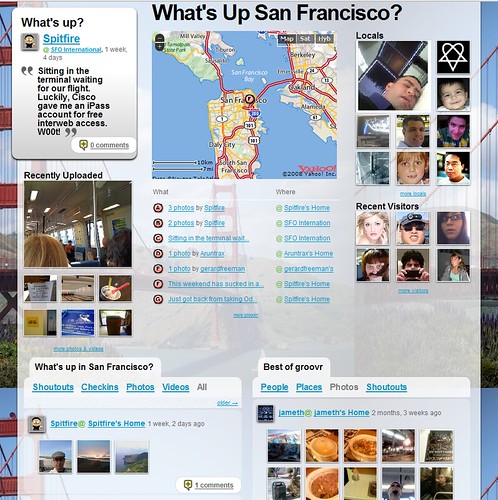
Groovr is your mobile network's night out on the town. Post a picture, message, or video to your Groovr profile and have it sent to all your friends too. Instant chat? Groovr's got you covered. However, some of these features are redundant. Can't we already send messages, pictures, and videos to our friends without a third party? The only feature we found remotely unique is a city's Explore page on Groovr. All of your posted items are sent to the corresponding cities Explore page. Here's a peek at San Francisco on Groovr:

Fon11

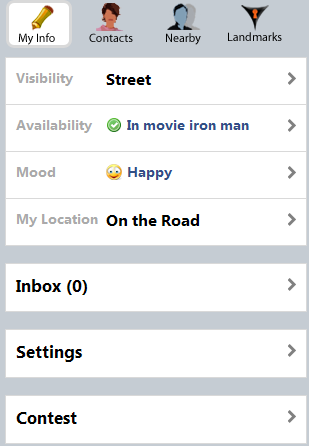
Developed by MoBlast Technologies, Fon11 could become the hottest mobile social network for the iPhone. With a nice UI (of course) and great features like the ability to see just how far away your contacts are from you, availability status messages, visibility settings and more, it seems Fon11 has a lot more to offer than the rest of the pack. Fon11 has already been ported to Android and Nokia Web Runtime with development plans in the works for J2ME and Windows Mobile platforms. While GPS remains an issue through no fault of Moblast, we've been assured that there are many strategies in development to find a resolution.

We hope you enjoyed this look at 10 interesting and exciting mobile social networks. The information in this post came from a variety of past ReadWriteWeb articles and we will continue to explore this promising market. In the meantime, please list your favorite mobile social networks in the comments below.

See also: Mobile Web Trends & Products, March '08 Update


Wednesday, December 24, 2008

Fanta Fuels The Fun With 3D Mobile Tennis Game That Connects Players Via Bluetooth

Wow.... this is cool. Thanks branding unbound


The Wii is so last week.

Coca-Cola's Fanta brand of orange soda is launching a mobile site with multiple branded mobile applications that have fun (and Fanta) spelled all over them, specifically for consumers in Europe.

One is a "virtual tennis" mobile game that connects two phones so players can compete via Bluetooth.

Players print out a "court" from a special microsite. They then can then view the court through their camera phones and hit the tennis ball by using the phones as virtual rackets (kind of like the recent augmented reality application from Ford's "Ka" automobile in Europe.

Another, called the Fanta Stealth Sound System, uses audio messages like "uncool," and "let's get out of here" in high-pitched frequencies that are only audible to people under 30.

Fanta virtual tennis mobile application “Fanta's brand positioning is about focusing on moments of enjoyment throughout your day, and the mobile phones are with you from when you wake up until you go to bed, ” Jeff Arbour, SVP of North America for The Hyperfactory (the solution partner behind the tennis game) tells DM News. “We thought [that] a light easy game that represented the brand's identity and personality” would work.

It's all part of an integrated print, online, on-pack, POS, viral and mobile marketing push, to begin in January.

Read all about it, here.

A Guide to The Contextual Web

Thsi article is long, but so good i had to copy the whole thing. Big thanks to ReadWriteWeb... oh and a great xmas/new years to all.

Written by Alex Iskold / December 22, 2008 9:00 PM / 18 Comments

It's the end of 2008 and everyone on the Web is hurting due to the economy. But we know that things will get better, because slow-downs eventually bury the old and give birth to new evolutionary ways of doing things.

One of these evolutions started quietly in 2008. We are witnessing the rise of a new kind of web: contextual. You might not have heard or thought about it much yet, but you are already using it today. Search remains the killer app on the web, but context is quickly become a viable contender. Why? Because context is what happens instead of search.

What Is The Contextual Web?

Until recently on the web, most sites have not been software - only data, a bunch of flat HTML pages. The software that you used to look at them was, of course, the web browser. The problem was that the browser had no idea what the pages contained, and it did not know what you were doing. Because the browser could not infer your context, it could not help you explore related and relevant information.

The contextual web experience is fundamentally different because there is an understanding of what the user is doing. The combination of the information on the page and the user's behavior creates the context. Once you understand the user's context, you can be more helpful. So, contextual technologies have the potential to bite into the pie that today belongs to search, because it is able to bypass search.

Consider the difference between looking at the IBM home page and a movie page on Netflix. The context is very different, and so likely is the user's intention. The user may be looking at IBM because she is looking for a job or researching IBM products. When the user is looking up a movie, it is because she is thinking about renting it.

The Key Properties of The Contextual Web

The Contextual web will happen when browsers and websites evolve to recognize what users are trying to do. It is the web with less choice and more meaning, where instead of Googling all the time, we Google once and then the rest of the information is available to us automatically, based on our current context.

Here are the key properties of the contextual web experience:

  • Relevancy: understanding the user's context better drives content relevancy.
  • Shortcuts: contextual shortcuts reduce the need for raw search.
  • Personalization: context is based on user intentions and history.
  • Remixing: relevant information from around the web is instantly available.

What are some specific examples of contextual technologies that are improving our web experience right now?

Markup Technologies

One of the keys to inferring user context is understanding the underlying information that the user is looking at. This is why the contextual web is related to -- and, to be more precise, is powered by -- semantic web. We have written a lot here on ReadWriteWeb about semantic technologies. Notably, we discussed the difference between the top-down and bottom-up approaches to semantic web, both of which are important for understanding the contextual web.

The bottom-up approach to context is about annotating pages. For example, all modern browsers can detect if the page you are looking at contains an RSS feed. This happens because the browser looks for a tag in the head of the page, which declares type . The fact that the page offers an RSS feed creates an obvious context: subscription. So, the browser then invites you to subscribe using your favorite RSS reader.

Another form of markup that has been discussed recently is microformats, which offer an XHTML-compliant way of embedding metadata about people, places, events, and reviews in existing web pages. Even though microformats are not ubiquitous today, there are clear benefits to using them. The image below is from an excellent post by Mozilla UI lead Alex Faaborg about leveraging microformats in the browser.

Building on the hAtom microformat are Web Slices, introduced by Microsoft in Internet Explorer 8. Web Slices enable publishers to notify users when the information in their web pages changes. For example, Weather.com can create a Web Slice that tells the user when a local weather update is available. eBay can deliver a Web Slice that notifies the user when the price of an auction changes. Similar in concept to RSS, Web Slices focus on updates in part of the web page, enabling publishers and users to communicate directly via the browser.

There are other markup formats that help provide context. For example, popular add-on Cooliris[disclosure: this is the company I founded], is called ABMeta. This format allows publishers to annotate pages that contain information about books, music, movies, wine, restaurants, stocks, and other everyday things. offers a markup format for signaling that a site contains images. By placing a bit of XML code in their home directory, site owners enable users to experience their images using the stunning 3D visualization developed by Cooliris. Another markup format, developed by AdaptiveBlue

All of these markup-based approaches face the same issue: publishers have to do the work of actually annotating the pages. And while the semantic web community has been very vocal about the benefits of annotation, the majority of the web is still flat HTML.

Widgets

In the meantime, we are seeing a surge in applications that deploy a top-down approach to inferring user context and being helpful. Instead of relying on markup in pages, these applications use heuristics and APIs to recognize the information that the user is interacting with. Based on their recognition, these smart tools then offer contextual shortcuts to the relevant bits of information. Speaking broadly, today there are two primary categories of top-down contextual applications: blog plugins and browser add-ons.

Blog plugins offering a contextual experience have been around for some time, starting with preview technologies. One of the first recent unsuccessful attempts at a preview technology was delivered by Browster. Despite its failure, its successors, CoolPreviews, SnapShots, and Apture, have done much better. While CoolPreviews literally focuses on a preview of the page, SnapShots and Apture deliver a compact summary of the information behind the link. The basic premise behind the previews is sound: if the user is not interested in what is behind the link, the preview can save the user an unnecessary click. Because the user context (in this case, the link) is known, relevant information can be brought to the surface and delivered to the user instantly.

Closely related to previews are widgets that offer contextual shortcuts. Like previews, these widgets work by being anchored to links. Examples of this technology include Yahoo! ShortcutsSmartLinks from my company AdaptiveBlue. Instead of providing a preview of the underlying content, these technologies offer links to related content around the web. The example below shows a SmartLink on a New York Times movie page, which invites the user, for example, to buy the movie on Amazon or rent it on Netflix. and

Our last example of contextual widget technology comes from Colorado-based Lijit. Lijit has developed a search technology that focuses on the individual. You claim your presence around the web, on blogs, Twitter, Flickr, etc., and then others can search your pages on specific topics. Say you are on someone's blog and want to do a search on that person; it makes the most sense to search through this person's pages first; after all, you are in this person's context.

Remarkably, Lijit offers another contextual nugget, called Re-search. It is simple, but a great example of the power of context. If you search for a term on Google and end up on a blog that has a Lijit widget, a header appears with additional results and a prompt to search for more. Lijit automatically infers your context, does a search, and offers additional helpful shortcuts.

Browser Add-Ons

Widgets and markup technologies are making inroads into the contextual web, but an even bigger inroad is being made by browser add-ons. Since Firefox introduced its platform for delivering additional features to the browser, many thousands of browser extensions have been developed. A lot of these extension focus on enhancing the browsing experience by leveraging context. Probably the granddaddy of them all is Greasemonkey, an extension that allows users to install bits of JavaScript that alter the look and content of web pages they visit. We wrote an introduction to this popular add-on and recently followed up with a post on 7 New Greasemonkey Tweaks.

While Greasemonkey scripts are mainly regarded as experimental tools for power users, quite a few other extensions are aimed at building a business around contextual enhancements to the browser. One example is a company called WebMynd, which focuses on enhancing Google search results. WebMynd's extension automatically pushes down Google ads (clever!) to insert its contexual gadget. It allows users to simultaneously search posts on Twitter, book matches on Amazon, video matches on YouTube, and many other sources. An example of what shows up when searching for "semantic web" using the gadget is shown below.

We have mentioned Cooliris several times already. The most popular Cooliris product is the browser add-on that shows stunning 3D views of photos and videos around the web. Cooliris works contextually by automatically recognizing popular photo sites like Flickr, Google Images and Photobucket. Another contextual add-on that works by recognizing content on pages is Glue. This add-on shows you friends and other users who have visited the same book, music, movie, restaurant, wine, and other pages around the web. The context here crosses the content you are viewing with your social graph. Unlike lifestreaming applications that deliver you information about your friends out of context, Glue only brings to the surface information that is relevant to your current context.

A very different example of a contextual web add-on comes from Slovenia-based Zemanta. Its add-on makes it easy for publishers to add contextually relevant links, photos, and video to their posts. Zemanta works by applying its semantic engine to the body of the post and automatically recommending related content. Using Zemanta, bloggers are able to instantly add relevant content to their blog posts, in turn creating a relevant web experience for their users.

Our last two examples of contextual add-ons are Zentact and App Discover, both recently launched. Zentact -- developed by the folks who brought us another contextual phenomenon, MyBlogLog -- aims to solve a problem of staying in touch with people who matter to you. First, you import and tag your email contacts with different tags that reflect their interests. Then, as you browse, Zentact pops up a reminder to contact a person if it deems the page relevant based on the tags. It is a simple yet powerful example of the contextual web.

App Discover works by recommending related applications to the sites that you are visiting. Today, it requires publishers to add markup to their sites, but one can easily imagine how this technology could work top-down. The example below shows App Discover recommending TweetDeck when the user navigates to Twitter.

Browsers

Without a doubt, web browsers are in the best position to deliver the user's contextual web experience. While add-ons are taken in a variety of directions, the two dominant browsers, Internet Explorer and Firefox, have already incorporated the basic contextual experience: shortcuts. Internet Explorer 8 features technology called Accelerators.

According to Microsoft, Accelerators give you ready access to the online services you use everyday, from any page you visit. Accelerators are defined as little chunks of XML based on pre-defined variables and defined by the browser. Some examples of variables available to Accelerator are the active URL, the active domain, and selected text. The most common action that Accelerators do is perform contextual search based on the user's selection. Another common Accelerator function is the in-place lookup, such as looking up a map based on a given address.

The problem with Accelerators is that they are not really based on a selection; that is, they lack semantics. When you highlight an address, you still have to decide which Accelerator to use. If you have dozens of Accelerators installed, this quickly becomes hard to manage. Firefox has recognized the issue with the menu-driven approach and instead offers its contextual technology via text. Called Ubiquity, this contextual technology is still only available as an add-on today but is likely to be a part of Firefox core soon.

Marketed as user-generated mashups, Ubiquity is actually a contextual technology based on language. As with Accelerators, the user is able to select a piece of text and then invoke Ubiquity and type a command. In the screenshot above, Ubiquity is used to insert a map into an email. Hundreds of Ubiquity commands have been implemented to date. ReadWriteWeb has already written about Ubiquity commands.

Will Context be the Future of the Web?

So where is all of this heading? Are these technologies signal or noise? We believe we are witnessing the birth of a fundamentally new kind of web, a smarter one, a contextual one. Unlike the old web we are used to, this one understands what we are doing and helps us. It is a web in which we search less and find relevant content faster. This new contextual web is still very young and unevenly distributed, but it is definitely here.

The fact that these contextual technologies are springing up is not accidental. The Contextual web is made possible by our push into semantic web and the rise of web services/API culture. The combination of basic semantics and API is fueling all of these contextual applications. Bit by bit, the web is getting smarter, friendlier, and more enjoyable.

Web browsers are in the best position to deliver these new contextual experiences to users because of their wide reach. The fact that Microsoft made Accelerators its flagship feature for Internet Explorer 8 and that Mozilla is putting much effort into Ubiquity tells us that contexual browsing is a priority. This is really good news, because these technologies bring great benefits to the user.

It is great to see that in these tough economic times, evolution is brewing. The tremendous effort that all of these companies are making with contextual technologies is beginning to come to fruition. It may be that we are seeing glimpses of what the next generation of the web will be like.

And now, as usual, let's turn the tables. Tell us examples of your favorite contextual browsing technologies. Do you think context will be play significant part in the next evolution of the web?